Get a free written quote for your Santa Ana home —
Get a free written quote for your Santa Ana home —
Equipment, plumbing and salt are three different costs. Here is how each one moves.
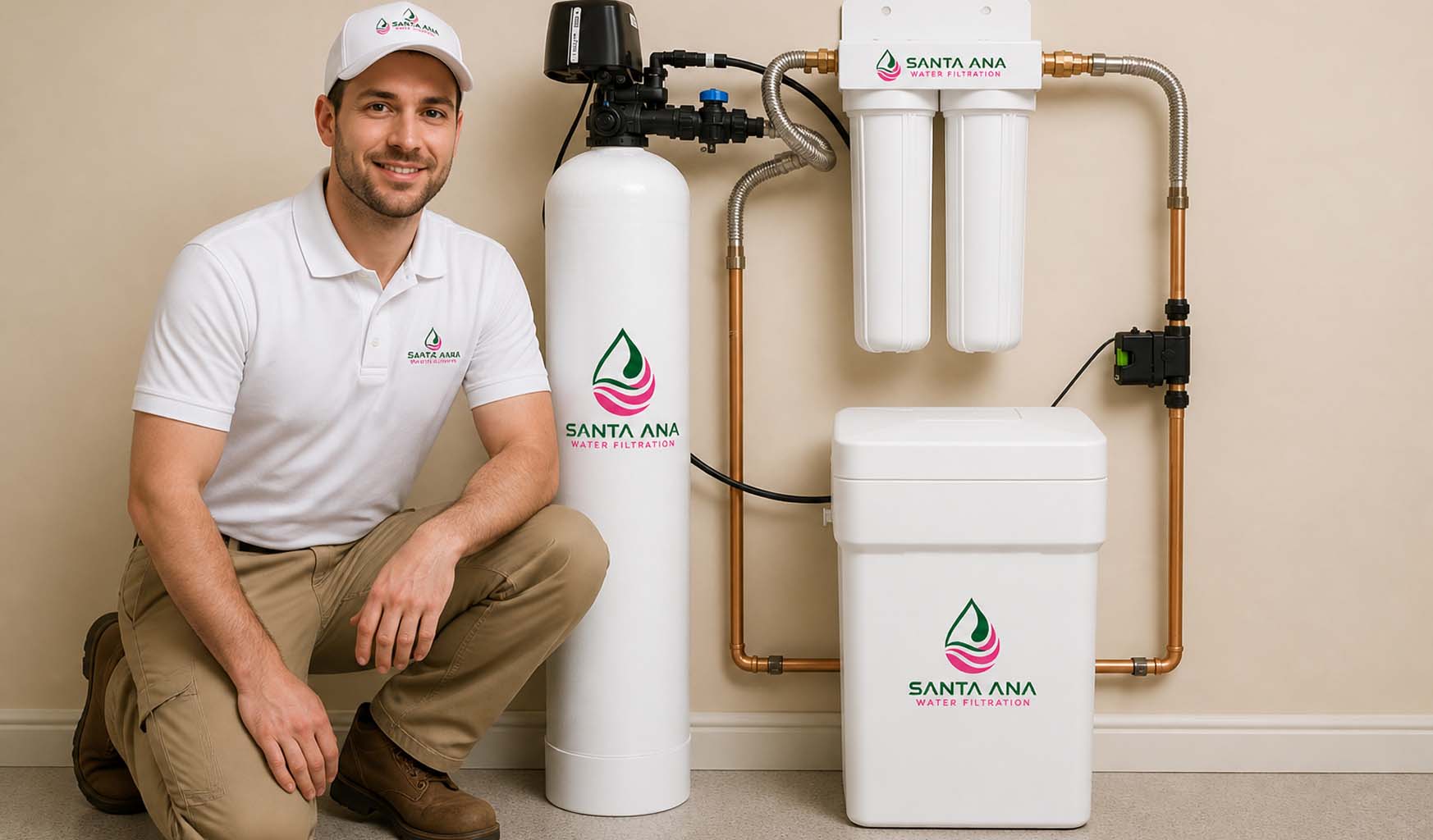
Two contractors can look at the same Santa Ana house, size the same softener, and hand you quotes that differ by thousands of dollars. Neither is necessarily wrong. A water softener cost in Santa Ana is three separate numbers stacked together: the equipment tier, the plumbing your house happens to have behind the drywall, and the salt and water the system quietly consumes for the next decade. This guide separates them, so you can read a quote and see which part is negotiable.
There is no single installed price for a water softener, and any company quoting one before looking at your plumbing is guessing. The easiest part of the bill to pin down is the hardware. Penn State Extension's guidance on water softening puts an average range for the hardware alone at roughly $500 to $1,500, with the spread driven by tank size, valve type and convenience features. That figure is equipment on a pallet, not a working system in your garage.
The labor half is where Santa Ana homes diverge. A house with a pre-plumbed softener loop in the garage is a short job: cut in, connect, run a drain line, set the valve. A house with no loop means a plumber is opening a wall or working a tight side yard to intercept the main after the meter. Ask every bidder to break the quote into equipment and installation as separate line items; once those two numbers are visible, most of the mystery in a wide spread disappears.
Hardness is not a health standard, which is why no utility is obligated to remove it. The EPA classifies hardness-related constituents under its secondary drinking water standards, a set of non-enforceable guidelines established, in the agency's words, “to assist public water systems in managing their drinking water for aesthetic considerations, such as taste, color, and odor.” Total dissolved solids carries a secondary limit of 500 mg/L, and the agency notes those contaminants “are not considered to present a risk to human health.”
That has a direct consequence for your wallet. Scale on the shower glass, a water heater working harder every year, and soap that refuses to lather are real costs, but they are yours to solve. The City of Santa Ana runs its own water system and publishes what it finds: its water quality page describes more than 120 constituents tested annually, with results compiled in a yearly Consumer Confidence Report. Pull that report and find your own hardness figure before you price anything — buying a softener without knowing the number you are softening is how people end up with a unit sized for someone else's house.
Equipment price tracks two things above all else: how the unit decides when to regenerate, and how much resin is inside it. The Water Quality Association describes hardness in grains per gallon as calcium carbonate equivalent, and defines soft water under NSF/ANSI standards as less than one grain per gallon. The grain number you need to remove is what determines the tank you need, and the tank is what determines the sticker.
At the entry tier you get a single-tank unit on a timer, regenerating on a fixed schedule whether the household used water that week or not. The mid tier swaps the timer for a metered, demand-initiated valve, which Penn State notes regenerates only “after so many gallons of water have been softened” — a difference that shows up in your salt bill rather than on the invoice. Above that sit twin-tank and high-efficiency systems that keep soft water available during regeneration and use less salt per grain removed. Salt-free conditioners are a separate category: the WQA groups physical and sacrificial anti-scale devices apart from ion exchange, and they do not lower your hardness number. They change how scale behaves, which is a legitimate goal but not the same product. Whatever tier you land on, look for third-party certification, which the WQA explicitly advises.
| Tier | What the valve does | Typical hardware range | Who it fits |
|---|---|---|---|
| Entry, single tank | Regenerates on a fixed clock, used or not | Lower end of the published range | Small households with steady, predictable use |
| Mid, metered demand | Regenerates by gallons actually softened | Middle of the published range | Most Santa Ana single-family homes |
| Twin tank or high efficiency | Keeps soft water on tap during regeneration, uses salt more efficiently | Upper end and above | Large households, high hardness, well water |
| Salt-free conditioner | No regeneration, no brine, no softening | Varies widely by technology | Scale control where brine discharge is restricted |
Four things decide whether an install is simple or expensive: loop, drain, power and space. A pre-plumbed loop is the single biggest cost swing. Newer tract construction and remodeled homes often have one waiting in the garage; the older housing stock in neighborhoods like Floral Park, French Park and Washington Square frequently does not, and retrofitting a tie-in on a main that may be galvanized or aging copper adds labor plus the risk of finding more pipe to replace once it is opened.
Drain access is the second. A softener has to dump brine somewhere, through an air gap to a standpipe, laundry drain or approved connection. A garage with a laundry hookup two feet away is cheap; a side-yard spot where the nearest drain is thirty feet off, or a condo near South Coast Metro where common plumbing is not yours to alter, is not. Metered valves also need a standard outlet within reach, which older garages do not always have.
Location changes the hardware too. A garage install is the Orange County default; an exterior side-yard spot exposes tanks to direct afternoon sun and usually means a protective cover and UV-stable fittings. Finally, budget for the permit step: plumbing tie-ins in Santa Ana run through the city's Building Safety Division, which moved permit and plan review applications onto the Accela online portal in July 2026. A contractor who never mentions a permit is either absorbing it or skipping it.
Operating cost is salt plus water, and both scale with your hardness number rather than the price of the machine. Every regeneration flushes the resin bed with brine and rinses it out. Penn State Extension puts the water used at roughly 50 gallons per cycle, so a unit regenerating twice as often as it needs to spends that twice as often, on your bill, for no benefit. That is the quiet argument for the metered tier, and it compounds over a ten-year life.
Salt consumption works the same way. The harder your water and the more gallons your household runs, the more grains the resin must exchange, and grains removed is what sets bags consumed. A larger tank is not more expensive to run; it is often cheaper, because it regenerates less often and recovers more capacity per cycle. The number worth asking any installer for is the grains-per-pound salt efficiency of the unit they are proposing. That one specification separates a system that is cheap to own from one that only looked cheap to buy.
Most price gaps between two bids are scope gaps, not margin. Before assuming the higher number is padded, check whether it covers a bypass valve, new shutoffs, a pressure regulator if yours is old, the drain line and air gap, haul-away of an existing unit, the permit, and a first fill of salt. Check the warranty split too: tanks, valves and labor are often covered for different lengths of time, and a long tank warranty beside a one-year labor warranty is not the same offer. Then confirm both bidders sized the unit from the same hardness reading. A quote built on a guessed number and one built on a measured one will disagree, and the cheaper is frequently the one that regenerates too often for the next decade.
Not sure what your water needs?Book a free in-home water test.
The number that moves your softener price most is not the brand on the tank, it is whether your house already has a loop and a drain where the equipment needs to go. Walk your garage and side yard before the first appointment and note what you find: an existing loop, the nearest drain, a nearby outlet, and how much clear floor space there is. Pair that with your hardness figure from the city's report, and every quote you receive afterward becomes comparable, because the bidders are finally pricing the same job.
If the walk-through turns up more questions than answers — no obvious loop, an unclear main line, or a hardness number you would rather have measured than looked up — that is the point where an on-site water test and a written scope are worth more than another phone estimate. Santa Ana Water Filtration handles water testing and analysis and water softener installation across the city, and can tell you which of these variables actually applies to your house before you start comparing numbers.
Related services: Water Softener Installation in Santa Ana and Santa Ana Water Filtration.
A quick in-home test shows exactly what your water needs. Talk to the local Santa Ana Water Filtration team.