Get a free written quote for your Santa Ana home —
Get a free written quote for your Santa Ana home —
Two numbers decide it — how hard your water is and how much your home uses. Here is how to size a softener for Santa Ana's hard water.
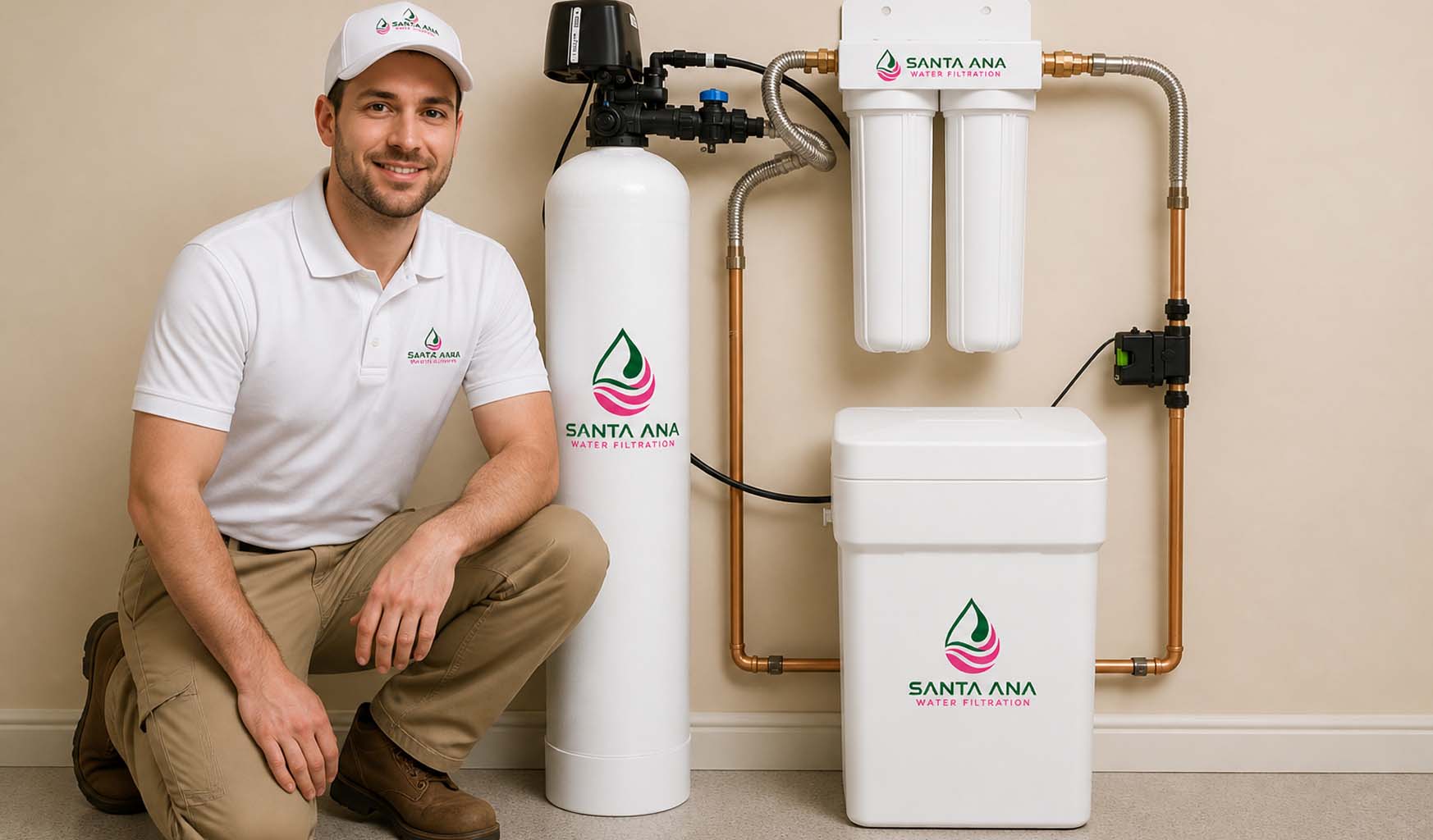
How big a water softener does a Santa Ana home actually need? It is the first real question most homeowners hit once they decide to deal with hard water, and getting it wrong in either direction costs money. Undersize the unit and it regenerates constantly, burns through salt, and wears out early. Oversize it and you pay for capacity you will never touch while the resin sits stagnant between cycles. The right size is not a guess or a showroom default. It comes from two numbers you can pin down before anyone sets foot in your garage: how hard your water is, and how much of it your household uses.
A water softener's size is its grain capacity: the number of grains of hardness it can pull out of your water before it has to regenerate and start over. Inside the tank is a bed of resin beads coated in sodium. As hard water flows through, the beads trade their sodium for the calcium and magnesium that make water hard, a swap called ion exchange. Eventually the beads fill up, and the unit rinses itself with brine from the salt tank to recharge, then goes back to work. A 32,000-grain softener, then, is one that removes 32,000 grains of hardness between those rinses. That single number, not the physical size of the tank, is what you are really buying and what you need to match to your home.
Santa Ana's water is hard enough that scale is a genuine, ongoing problem for most homes. The city's most recent water quality report puts total hardness at an average of 159 mg/L as calcium carbonate, ranging from 137 to 175 mg/L across its sources. Because one grain per gallon equals 17.1 mg/L, that average works out to about 9 grains per gallon, which sits squarely in the hard range. The reason traces back to where the water comes from. The Orange County Water District manages the groundwater basin that supplies roughly 85 percent of the water for 2.5 million people in north and central Orange County, and Santa Ana draws most of its supply from that basin through 21 city wells, blended with imported water. As groundwater moves through the aquifer it dissolves calcium and magnesium from rock and soil, and those two minerals, as the Water Quality Association notes, are what cause most of the scale you see building up in pipes, fixtures, and water heaters. Knowing your starting hardness is the anchor for every sizing decision that follows.
Your daily softening demand is simply your number of people multiplied by daily water use multiplied by your water's hardness in grains per gallon. A widely used planning figure is 75 gallons of water per person per day, which covers showers, laundry, dishes, and cooking for an average household. Run the math for a four-person Santa Ana home at 9 grains per gallon: 4 people times 75 gallons is 300 gallons a day, and 300 gallons times 9 grains is 2,700 grains of hardness to remove every day. Over a week that is roughly 18,900 grains. You do not want a softener that only barely covers that number, because regenerating daily wastes salt and water and shortens resin life. Instead you size so the unit carries several days of demand and regenerates about once a week, which is where efficiency and longevity both peak.
Most Santa Ana households land on a softener rated between 32,000 and 48,000 grains, and a four-person home is commonly well matched by a 32,000-grain unit. The reason the rated number is higher than a week of demand is that softeners are most salt-efficient when they are not run all the way to their maximum capacity, so you want headroom. As a rough guide for local hardness: a one- to two-person household is usually fine with 24,000 to 32,000 grains; a three- to four-person household with 32,000 to 40,000 grains; and a five- to six-person household with 40,000 to 48,000 grains. These are starting points, not final answers, because they assume around 9 grains per gallon and no complicating factors. A tested hardness on the higher end of the city's range, or unusually heavy use, nudges every one of these tiers up a step.
Not sure where your home lands? A quick in-home water test pins down your exact hardness so you size the system once and size it right.
Beyond people and hardness, three things most often move the right size: iron, irrigation, and your plans for the house. If your water carries iron, which some local groundwater and many private wells do, that iron has to be added to your hardness as compensated hardness, and it can meaningfully raise the capacity you need or call for dedicated iron and sulfur removal ahead of the softener. A large lot with thirsty landscaping pushes daily gallons well past the 75-per-person rule, so demand climbs. And if you run or plan to add a tankless water heater, protecting it from scale is a strong reason not to cut the softener too small, since scale is exactly what shortens a heater's life. Each of these is a case where the textbook number and the right number diverge.
A common worry is that a larger softener will load your water with sodium, but the amount of sodium added depends on how much hardness you remove, not on the size of the tank. Ion exchange trades a small amount of sodium for the calcium and magnesium it pulls out, so at Santa Ana's hardness the added sodium is modest and roughly the same whether you run a 32,000-grain or a 48,000-grain unit at the same demand. For context, the city's 2025 report already lists sodium in the supply averaging 43.9 mg/L before any softening. If anyone in the home is on a strict sodium-restricted diet, the usual answers are to run the softener only on the hot and hard-water lines, switch to potassium chloride in the brine tank, or keep a separate reverse osmosis tap for drinking and cooking. None of that changes your grain math; it just changes what you refill the salt tank with.
Buying the biggest softener on the shelf to be safe sounds prudent, but oversizing has real downsides. A unit that is far larger than your demand does not regenerate often enough, which lets the resin bed sit in stagnant water and can allow channeling, where water carves narrow paths through the resin and slips past unsoftened. You also pay more upfront for capacity you will not use, and larger units can draw more salt and backwash water per regeneration if they are not dialed in correctly. Bigger is not automatically better here; correctly matched is better. The goal is a unit sized so it works steadily, regenerates on a healthy weekly rhythm, and neither strains nor loafs.
Sizing a softener well is mostly a matter of refusing to guess. Start with a real measurement of your home's hardness, because the citywide average is a useful anchor but your tap can read higher or lower depending on your neighborhood and the time of year. Do the simple demand math, size up for a weekly regeneration, and then adjust for iron, a large household, or irrigation before you commit to a number. If you would rather not chase the calculation yourself, that is exactly where a local test earns its keep. The team at Santa Ana Water Filtration can measure your water, walk you through the grain math for your household, and match a right-sized system through professional water softener installation rather than a one-size-fits-all box.
Related services: Water Softener Installation and Scale Prevention & Water Heater Protection from Santa Ana Water Filtration.
A quick in-home test shows exactly what your water needs. Talk to the local Santa Ana Water Filtration team.