Get a free written quote for your Santa Ana home —
Get a free written quote for your Santa Ana home —
The pool smell is on purpose and almost always harmless. Here's why it happens, why it comes and goes, and how to get rid of it.
You fill a glass at the kitchen sink, lift it, and there it is: a faint whiff of swimming pool. For a lot of Santa Ana homeowners the chlorine smell in their tap water is the single most noticeable thing about it, and it raises an obvious question. Is that smell a problem, or just something to live with? The short version is that the chlorine is there on purpose, it is almost always harmless, and if it bothers you it is one of the easiest water complaints to fix. Here is why your water smells the way it does and what actually stops it.
Chlorine smells because it was added on purpose, as the disinfectant that keeps your water safe on the trip from the treatment plant to your tap. As the Centers for Disease Control and Prevention explains, water systems add a disinfectant so that a residual remains in the pipes, and that leftover disinfectant keeps killing germs living in the pipes between the treatment plant and your home. In other words, the chlorine you smell is doing its job right up to the moment the water leaves your faucet. Santa Ana's most recent water quality report backs this up, listing a chlorine residual in the distribution system that ranges from none detected up to 2.9 parts per million, well within the limits set for a safe disinfectant level. A noticeable smell is simply the high end of that normal range reaching your particular tap.
A chlorine smell is not, on its own, a sign that something is wrong with your water. Chlorine taste and odor fall under what the Environmental Protection Agency calls secondary drinking water standards, a set of guidelines for qualities like taste, color, and smell that are about aesthetics rather than health, and are not federally enforced. The EPA even assigns odor its own aesthetic threshold rather than a health limit. Santa Ana, for its part, reports that its water meets state and federal standards and tests for well over 120 constituents each year, and the city has publicly touted its tap water's taste. So a pool-like smell is best read as a cosmetic quirk of disinfected water, not an alarm. The exception worth knowing: if the smell is more rotten egg than pool, that points to sulfur or bacteria rather than chlorine, and that is a different problem worth testing for.
If the smell seems to come and go, that is normal too, and it usually traces to how your water is sourced and delivered. Santa Ana blends water from 21 local groundwater wells with imported supply that arrives through Metropolitan Water District connections and originates from the State Water Project and the Colorado River, treated at the Diemer and Weymouth plants. The proportion of local to imported water shifts through the year, and different sources carry different disinfectant character, so the taste and smell at your tap can change from one month to the next. Where your home sits in the distribution system matters as well, since chlorine levels are typically higher closer to a treatment source. Warm weather plays a part, because chlorine off-gasses faster from warm water, which is why the smell can seem stronger in summer or from the hot tap.
Before you spend a dollar on equipment, a few no-cost tricks often take the edge off. Because chlorine is volatile, it escapes water on its own given a little time and air. Try these first:
Not sure if it's chlorine or something else? A quick in-home water test confirms what is in your water so you buy the right filter once instead of guessing.
If those do not go far enough, the reliable fix for chlorine taste and smell is carbon filtration. Activated carbon works by adsorption, grabbing the chlorine and the compounds that carry its taste and odor as water passes through. This is exactly the job carbon is built for; the CDC notes that activated carbon filters are used mainly to improve the taste and smell of water. Carbon shows up in everything from a simple pitcher to an under-sink cartridge to a whole-house tank, and the differences between them come down to how much of your water you want treated. One point worth flagging: if your water is disinfected with chloramine rather than free chlorine, ordinary carbon is less effective and a catalytic carbon designed for chloramine does a better job, which is a good reason to confirm what you are dealing with before buying.
It is worth knowing exactly which disinfectant you are dealing with, because it changes what will actually fix the smell. Santa Ana's 2025 water quality report lists a chlorine residual in the distribution system, and free chlorine is the more volatile of the two common disinfectants, meaning it off-gasses and is removed by standard carbon fairly easily. Chloramine, a longer-lasting compound of chlorine and ammonia that many Southern California suppliers use on imported water, behaves differently: it does not air out the way free chlorine does, and it needs a catalytic carbon media to remove effectively. Because Santa Ana mixes local and imported water, the character at your tap can lean one way or the other depending on the blend at the time. That is the practical reason to confirm what is in your water before you buy a filter, rather than grabbing whatever pitcher is on sale and hoping the smell goes away. A quick test settles it and points you at the right media.
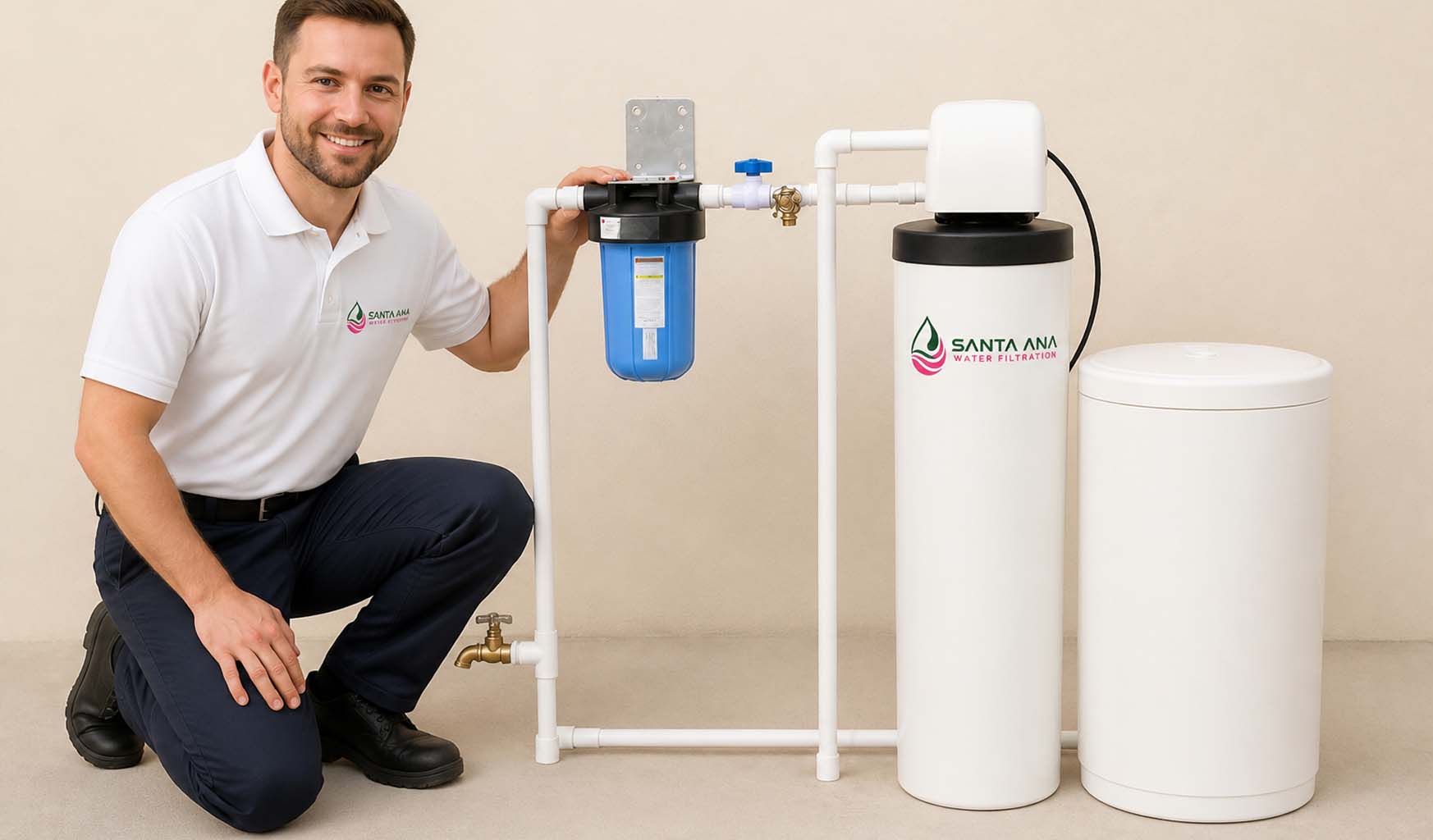
So should you filter at one tap or the whole house? It depends on where the smell bothers you. If you only care about drinking and cooking water, a pitcher or an under-sink carbon filter at the kitchen sink is inexpensive and effective. If you also want chlorine-free showers, where warm water releases the most odor and where chlorine can be drying on skin and hair, or you want it out of the water your laundry and appliances use, a whole-house carbon system treats every tap at once. Neither is the automatically correct answer. A household focused on better-tasting coffee has different needs than one where someone reacts to chlorine in the shower, and the right choice follows the complaint.
The most useful thing you can do before buying a filter is make sure you are solving the right problem. Confirm the smell really is chlorine and not sulfur, check whether it is coming from the hot side or the cold, and decide whether you want the fix at one tap or throughout the house, because those answers point to very different equipment. Chlorine odor is one of the most treatable water issues in Santa Ana, so there is no reason to put up with a pool-scented glass if it bothers you. When you want a straight read on what is in your water and which approach fits, the team at Santa Ana Water Filtration can test your tap and match you with carbon filtration or a whole-house water filtration system sized to the problem you actually have.
Related services: Carbon Filtration Systems and Whole-House Water Filtration from Santa Ana Water Filtration.
A quick in-home test shows exactly what your water needs. Talk to the local Santa Ana Water Filtration team.