Get a free written quote for your Santa Ana home —
Get a free written quote for your Santa Ana home —
The tap water is compliant, so is an under-sink RO system worth it? What it removes, what's in local water, and how to choose.
Santa Ana is not shy about its water. The city reports testing for more than 120 different constituents every year and says its supply meets or beats state and federal drinking water standards. So if the tap water is already compliant, is a reverse osmosis system under your kitchen sink actually worth it, or is it money spent solving a problem you do not have? The honest answer is that it depends on what you want your drinking water to do, and on a few specific numbers from your own tap. This guide lays out what reverse osmosis really removes, what is actually in Santa Ana water, and how to decide whether it earns its place.
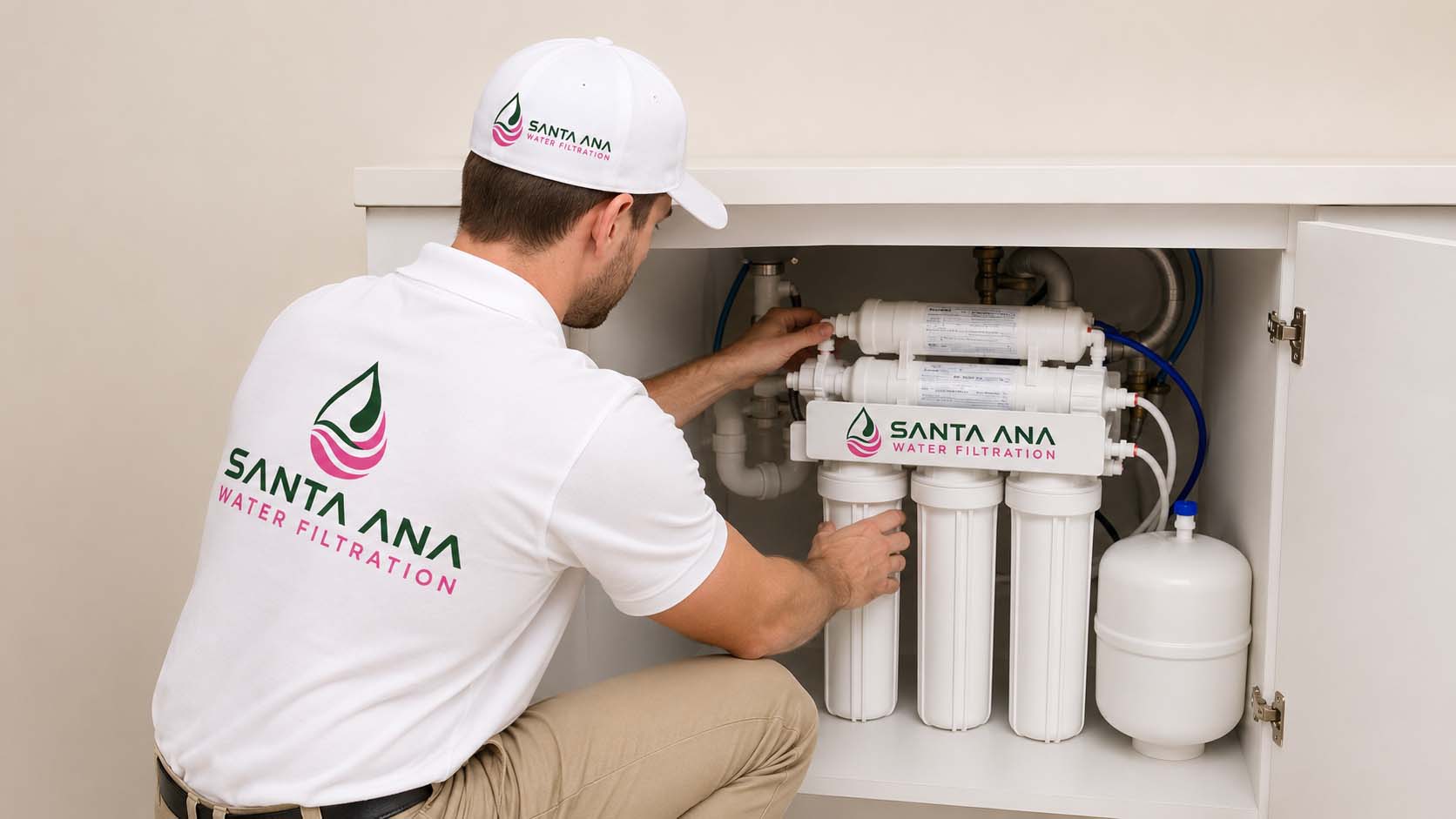
Reverse osmosis is a filtration method that pushes water through a membrane so fine that most dissolved solids cannot follow it through. Where a basic carbon filter mainly improves taste and smell, reverse osmosis reaches further. The Centers for Disease Control and Prevention describes reverse osmosis filters as able to remove germs and some chemicals from water, specifically naming lead, copper, chromium, chloride, and sodium among them. A typical under-sink system stacks several stages: a sediment pre-filter, one or two carbon stages, the RO membrane itself, and a final polishing filter, feeding a small storage tank and a dedicated faucet. The result is water with a large share of its dissolved content stripped out, which is exactly why it tastes different and why it can target contaminants a pitcher filter leaves behind.
To decide whether that is worth it, you have to know what you are starting with. Santa Ana draws most of its supply from the Orange County Groundwater Basin through 21 city wells, blended with imported water from the State Water Project and the Colorado River. That blend is hard and mineral-rich. The city's 2025 water quality report lists total dissolved solids averaging 396 mg/L, which is below the federal secondary guideline of 500 mg/L that the Environmental Protection Agency ties to taste, hardness, and deposits, but high enough that many people notice a mineral flavor. Hardness averages 159 mg/L, sodium 43.9 mg/L, and hexavalent chromium, or chromium-6, averages 1.4 parts per billion. For perspective, the EPA's enforceable drinking water standard covers total chromium at 100 parts per billion and assumes, conservatively, that all of it is the more toxic chromium-6. Santa Ana's level sits far under that limit, but it is not zero, and for some households that distinction matters.
For those households, reverse osmosis makes a strong case. If your main complaint is taste, RO removes the dissolved minerals and the salty or flat edge that high total dissolved solids can give water, usually producing a noticeably cleaner, crisper glass. If your concern is specific contaminants, RO is one of the few point-of-use methods that meaningfully reduces dissolved metals and salts rather than just improving odor. That is the appeal for residents who want to bring chromium-6, elevated sodium, or per- and polyfluoroalkyl substances down at the tap they actually drink from, on top of whatever the utility already does. It also gives you consistency: a well-maintained system delivers the same quality glass after glass, independent of seasonal swings in the groundwater-to-imported blend that can change how the tap tastes month to month.
Reverse osmosis is not free of trade-offs, and a good decision weighs them honestly. The most cited downside is water use, because RO membranes send a portion of your water to the drain as concentrate; older systems were notably wasteful, while newer efficient designs have narrowed that gap considerably. There is also the matter of what RO takes out that you might want to keep. The process removes beneficial minerals along with the unwanted ones, which some people find makes the water taste flat, so many systems add a remineralization stage to put a little back. The CDC also points out that filtering water that is already free of harmful contaminants removes helpful additions like fluoride, a real consideration for families relying on fluoridated water for dental health. Add the slower flow from a storage tank, the space it takes under the sink, and the periodic filter and membrane changes, and RO clearly asks more of you than a simple carbon cartridge.
Per- and polyfluoroalkyl substances, known as PFAS or forever chemicals, have been a real concern for Orange County groundwater, and Santa Ana's 2025 water quality report does list detections of certain PFAS compounds in its supply. The Orange County Water District, which manages the basin most of the city's water comes from, has invested heavily in treatment to remove these compounds before the water reaches customers. For a homeowner who wants an added barrier at the tap they drink from, reverse osmosis is one of the point-of-use methods capable of reducing PFAS in drinking water, which is part of why some residents choose it even though the utility is already treating for them. If PFAS is your specific worry, look for a system independently certified to reduce it and confirm your own tap results before deciding.
Want to know what's actually in your glass? A quick in-home water test shows your real total dissolved solids, hardness, and chromium-6 numbers so you are deciding on facts, not citywide averages.
So how do you actually choose? Start by naming the problem you are trying to solve. If your issue is chlorine taste or smell, or you just want better everyday drinking and cooking water, a carbon filter is often enough, since the CDC notes that activated carbon filters are built mainly to improve taste and odor. If your issue is dissolved solids, a mineral or salty flavor, or a specific contaminant like chromium-6 or PFAS that you want reduced at the tap, reverse osmosis is the tool that addresses it. Many Santa Ana homes split the difference: a whole-house or under-sink carbon filter for chlorine and general taste, plus a reverse osmosis unit at the kitchen sink for drinking and cooking. The right answer is not the same for every home, which is why testing your specific water first, rather than reacting to the citywide averages, is the step that turns a guess into a decision. If you want that clarity, Santa Ana Water Filtration can test your tap and walk you through whether a reverse osmosis system or a simpler under-sink drinking water filter fits what your water and your household actually need.
Not necessarily. The city reports that its water meets state and federal standards and tests for more than 120 constituents each year, so for most homes filtering is about preference and specific concerns rather than a safety emergency. Reverse osmosis earns its place when you want to reduce dissolved solids or a particular contaminant at the tap you drink from.
Yes, at the tap it serves. RO reduces the calcium and magnesium that make water hard, so the water from an RO faucet is soft to drink. But it only treats that one faucet, so it will not stop scale on your water heater or in your shower. Whole-home hardness is a job for a water softener, not a single under-sink RO unit.
RO membranes send a share of your water to the drain as concentrate, so the system uses more water than it delivers to the tank. Older units were notably wasteful, but modern high-efficiency designs have narrowed that gap considerably. If water use matters to you, ask about an efficient system when you compare options.
Choose a carbon filter if your main goal is removing chlorine taste and odor, because that is what carbon is built to do. Choose reverse osmosis if you want to lower total dissolved solids or reduce a specific dissolved contaminant such as chromium-6. Many Santa Ana homes use both, with carbon handling general taste and an RO tap handling drinking water.
Related services: Reverse Osmosis Systems and Under-Sink Drinking Water Filters from Santa Ana Water Filtration.
A quick in-home test shows exactly what your water needs. Talk to the local Santa Ana Water Filtration team.