Get a free written quote for your Santa Ana home —
Get a free written quote for your Santa Ana home —
Cartridge intervals, softener salt checks, and the seasonal jobs that keep a home water system working on Santa Ana's well-and-import blend.
Santa Ana's tap water arrives as a blend. Twenty-one city wells pull from the Orange County Groundwater Basin, and seven pipeline connections bring in treated supply from the Metropolitan Water District. The mix shifts through the year, and the load your equipment carries shifts with it. How often you should change a water filter in Santa Ana therefore depends far less on the date printed on the box than on what that blend is doing to the cartridge. What follows is a maintenance schedule built around local water: cartridge intervals, softener salt, membranes, and the signs that something is overdue.
A water filter's real service life is a gallon rating, not a date on the calendar. Manufacturers print an interval because a date is easy to remember, but that number assumes a household of a certain size drinking a certain volume of water of a certain quality. Two of those variables are yours. The third belongs to your water utility.
The consequence is practical. A couple using an under-sink filter only for drinking may get fifteen months from a cartridge rated for twelve, while a family of five that also cooks and fills bottles from the same tap can exhaust it in half that time. Sediment shortens it further, and so does a high disinfectant residual, because chlorine and chloramine are consumed by activated carbon rather than simply trapped by it.
The printed interval is a ceiling, not a schedule: replace at the stated interval or the gallon rating, whichever arrives first, and shorten the gap when your water or your household says to.
Local water chemistry is what shortens filter life here, and Santa Ana's numbers are public. The city's 2025 Water Quality Report puts total hardness in the distribution system at an average of 159 mg/L as calcium carbonate, ranging from 137 to 175, which works out to roughly nine grains per gallon. Chlorine and chloramine residual averages 1 ppm across the system and has been measured as high as 2.9 ppm.
Those two figures do most of the work. Hardness is what scales a reverse osmosis membrane and what softener resin spends its capacity on. Disinfectant residual is what a carbon block consumes. Both move with the blend, and the blend moves with the season: most of the city's supply comes from 21 groundwater wells, with imported water arriving through seven connections and treated at Metropolitan's Diemer plant in Yorba Linda and Weymouth plant in La Verne.
Imported water is the harder of the two on equipment. Total dissolved solids in Metropolitan's treated supply average 536 ppm against 239 ppm in local groundwater, so when your part of the city draws more imported water, every cartridge is working against a heavier load than the label assumed. Two further factors push in the same direction:
Carbon is the component Santa Ana's water retires fastest. Activated carbon removes chlorine and chloramine through reaction, so its capacity is finite and spends down in proportion to the residual it sees. A block in a home near the top of the reported range reaches the end of its life measurably sooner than the same block a few miles away. If chlorine taste or smell returns before the printed interval is up, the cartridge is telling you the truth and the label is not.
A filter that has stopped removing anything still lets water through. Flow is never proof that a system is working.
Treat the intervals below as a starting point and adjust from the first cartridge you pull. The right schedule is the one your own equipment confirms.
| Component | Typical interval | What shortens it here |
|---|---|---|
| Sediment prefilter | Three to six months | Turbidity in the blend; nearby main work |
| Carbon block or prefilter | Six to twelve months | Residual measured as high as 2.9 ppm |
| Reverse osmosis membrane | Two to five years | Hardness, dissolved solids, a spent prefilter |
| RO polishing post-filter | About twelve months | Long idle stretches |
| Whole-house carbon media | Three to five years | Household volume and residual |
| Softener salt | Look monthly | Regeneration frequency, household size |
| Softener resin bed | Eight to fifteen years | Chlorinated water with no carbon ahead |
Checking softener salt is a monthly job that takes about thirty seconds. Lift the brine tank lid and look: the salt should sit above the water line and below the rim, and it should look loose rather than crusted. Refill once it drops to roughly a third of the tank.
The reason to look rather than to schedule is that softeners do not consume salt evenly. Most modern units regenerate on demand, so houseguests, a heavy irrigation season, or a shift in the supply blend moves salt use noticeably. Penn State Extension describes regeneration as backwashing the resin with a brine solution that carries away the calcium and magnesium the resin has collected, which means salt use tracks hardness removed rather than days elapsed.
A tank whose level has not moved in two months is not being thrifty. It usually means the unit has stopped regenerating, or that a salt bridge has formed: a hardened crust spanning the tank with empty space beneath it, so the water below never reaches the salt and the resin never recharges. Break the crust with a broom handle and watch the level that week.
Not sure what your water needs?Book a free in-home water test.
Plan on emptying and cleaning the brine tank every two to three years, and sooner if you use rock salt rather than pellets. Sediment carried in with the salt settles into a sludge that interferes with the float and the brine draw. The tank comes clean with warm water, a stiff brush, and a rinse: an afternoon, not a service call.
The resin bed is a separate question on a longer horizon. Penn State Extension notes that resin can be fouled by iron and by biological growth, and that fouled resin is treated with commercial cleaners rather than simply flushed. On a chlorinated municipal supply the more common problem is the opposite one: chlorine slowly degrades resin beads, which is a good argument for keeping carbon filtration ahead of a softener rather than behind it.
An unmaintained system is not neutral. The Minnesota Department of Health puts it plainly: treatment units that are not properly maintained lose their effectiveness over time, and in some cases an unmaintained unit can make water quality worse and can make you sick.
The mechanics are unglamorous. A carbon cartridge past its capacity keeps collecting organic material while no longer holding back a disinfectant residual, which makes it hospitable to bacteria. A clogged sediment prefilter drops pressure across the house and starves the reverse osmosis unit behind it, so the membrane works against a deficit and fails years early. A softener that has stopped regenerating sends the full 159 mg/L back to the water heater, and scale in a tankless unit is the expensive end of this list.
The arithmetic is not close. A sediment cartridge costs a few dollars, an RO membrane a fraction of the system it protects, and a replaced water heater more than a decade of filters. Deferred maintenance here does not save money; it moves the bill to a larger account.
Two checks a year catch most of what a monthly salt look misses. In late spring, before summer use and irrigation push volume up, change the sediment and carbon prefilters together and read the pressure gauge if your whole-house system has one. A noticeable drop across the filter housing means the media is loaded and the rest of the system is paying for it.
In autumn, work the other side of the season. Check fittings, seals, and under the sink for the slow drips summer pressure swings tend to start. Confirm the softener's bypass valve still moves freely, since a seized bypass turns routine service into a shutoff-valve problem. Then run a fresh water test, so you know what the system delivers after a heavy-use summer rather than on install day.
If nobody in the house can say when the last filter change happened, do not reconstruct the schedule. Start it over. Pull the sediment and carbon cartridges and look at them, because a filter that comes out dark, slimy, or grit-stiff has already answered the question. Replace those two, check the brine tank the same afternoon, and write the date on the housing in marker. One dated cartridge turns every future decision into arithmetic instead of guesswork.
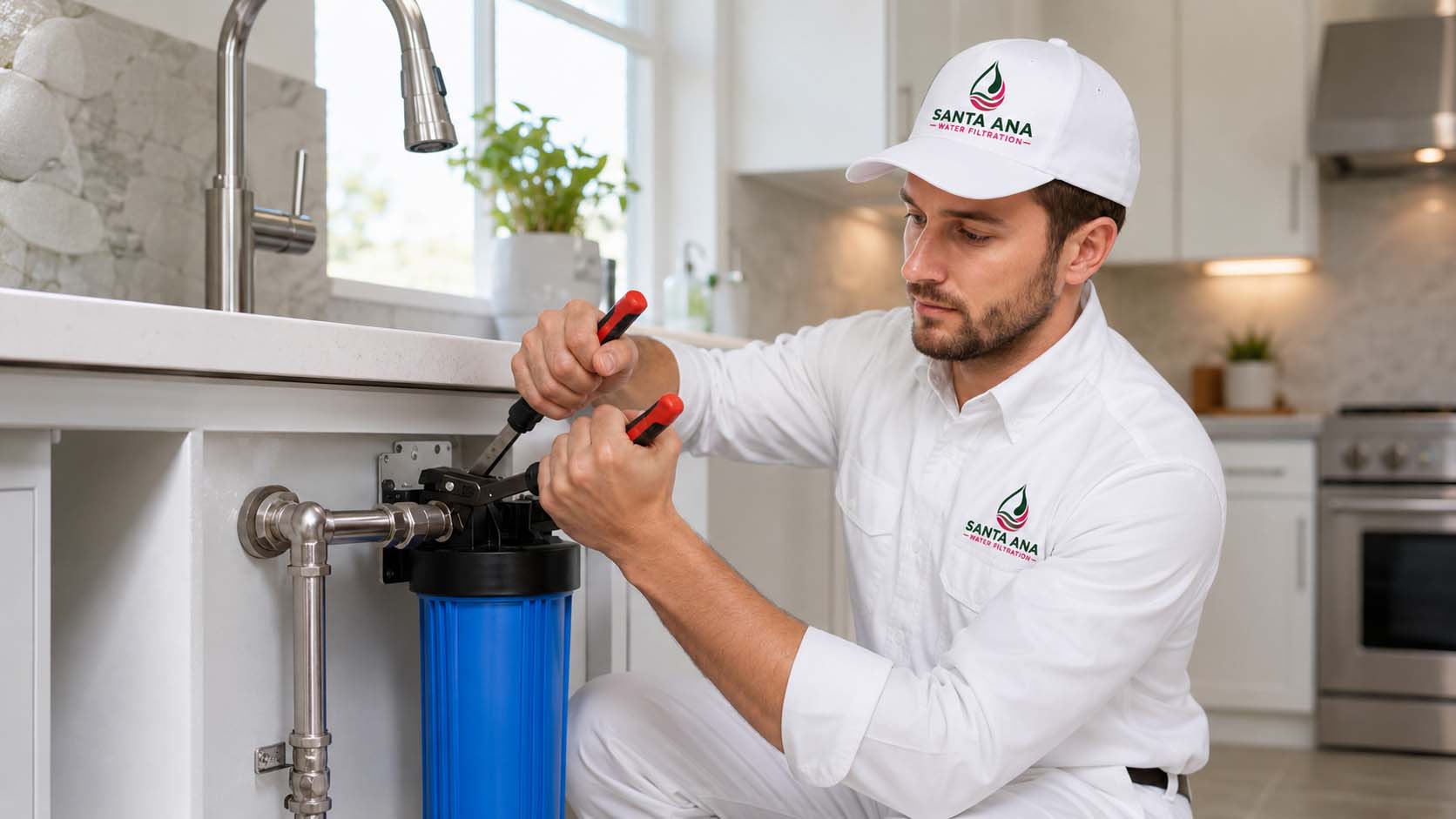
If what comes out looks bad enough to worry you, or if pressure and taste do not recover after a change, that is the point where having someone look at the whole system earns its keep. Santa Ana Water Filtration handles water filter repair and maintenance across the city and services equipment it did not install, including water softeners and reverse osmosis units.
Related services: Water Filter Repair & Maintenance and Santa Ana Water Filtration.
A quick in-home test shows exactly what your water needs. Talk to the local Santa Ana Water Filtration team.